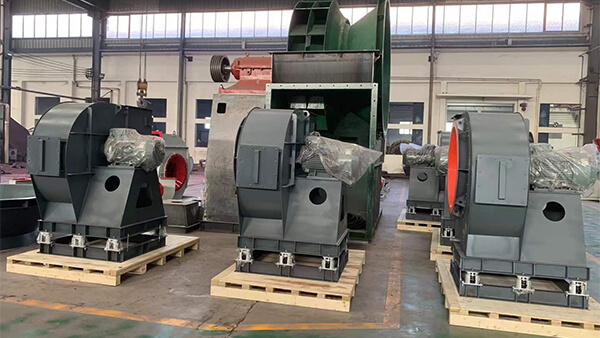
Direct answer: For continuous rotating service, standard carbon steel impellers are typically limited to about 400°C, above which creep and surface scaling combine with centrifugal stress to shorten service life. Austenitic stainless steel (304/321/347) extends the practical ceiling to roughly 600–650°C in most blower designs — even though the material’s raw oxidation resistance goes considerably higher. Beyond about 650°C, heat-resistant alloy grades or actively cooled designs are typically required.
Why the “Practical” Limit Is Lower Than the Datasheet Limit
Generic material datasheets usually quote an oxidation or scaling resistance temperature — the point at which a static, unloaded piece of metal starts to degrade in air. A blower impeller is a different case: it is a rotating part under continuous centrifugal stress, and that stress compounds with the reduced yield strength and creep resistance the material already loses at elevated temperature. As a result, the temperature a fan engineer should design to is generally well below the number printed on a generic material datasheet.
Temperature Limits by Material
| Material | Practical Continuous Limit for a Rotating Impeller | Governing Limit | Typical Blower Duty |
| Carbon steel (Q235B / A36-equivalent) | ~400°C | Creep + strength loss combined with centrifugal stress; surface scaling accelerates above this range | General industrial air, ambient to moderate process-gas temperature |
| Low-alloy Cr-Mo steel (15CrMo / ASTM A387 Gr.11-12 equivalent) | ~550°C | Creep strength of the alloy | Kiln preheater fans, moderate high-temperature ID fans |
| Austenitic stainless steel (304H / 321 / 347) | ~600–650°C | Creep/strength drop-off under rotating stress, despite higher static oxidation resistance | High-temperature ID fans, combined corrosive + high-temperature duty |
| Heat-resistant / high-Ni alloys (e.g., 310S, Incoloy 800H) | 700°C+ | Specialist alloy selection and cooling design | Extreme kiln off-gas, waste incineration, and similar severe-duty service |
For reference, standard 304/316 stainless steel can resist oxidation in static, unloaded service up to roughly 850–870°C — but that figure describes scaling resistance, not a safe design point for a stressed, rotating impeller, which is why blower OEMs generally hold to the more conservative 600–650°C figure above.
5-Step Material Selection Checklist
- Confirm the actual continuous gas temperature at the impeller — not the peak upset temperature the process occasionally reaches. Continuous duty and short-term excursions call for different safety margins.
- Separate continuous duty from intermittent upset conditions. A brief excursion tolerates a higher peak temperature than a material’s continuous design limit, provided the duration and frequency are bounded and specified.
- Treat published datasheet limits as a starting reference only. Rotating stress adds to thermal stress, so the actual design limit for an impeller should come from the material’s allowable-stress-versus-temperature curve, not a generic oxidation resistance figure.
- Check for co-factors that lower the effective limit further — corrosive gas combined with high temperature often requires stainless or FRP construction regardless of temperature alone, and abrasive dust combined with high temperature typically adds a wear-resistant liner requirement on top of the base material choice.
- Above roughly 600°C sustained, evaluate the bearing housing cooling method alongside the impeller material. Material selection alone does not resolve heat conduction into the bearing housing — a water-cooled bearing housing is usually needed at this range regardless of which alloy is used.